I Didn’t Just Chat With AI. I Built My Life and Work Around It.

After 31,000+ messages with AI in one year, continuity no longer felt like a feature. It felt like infrastructure.
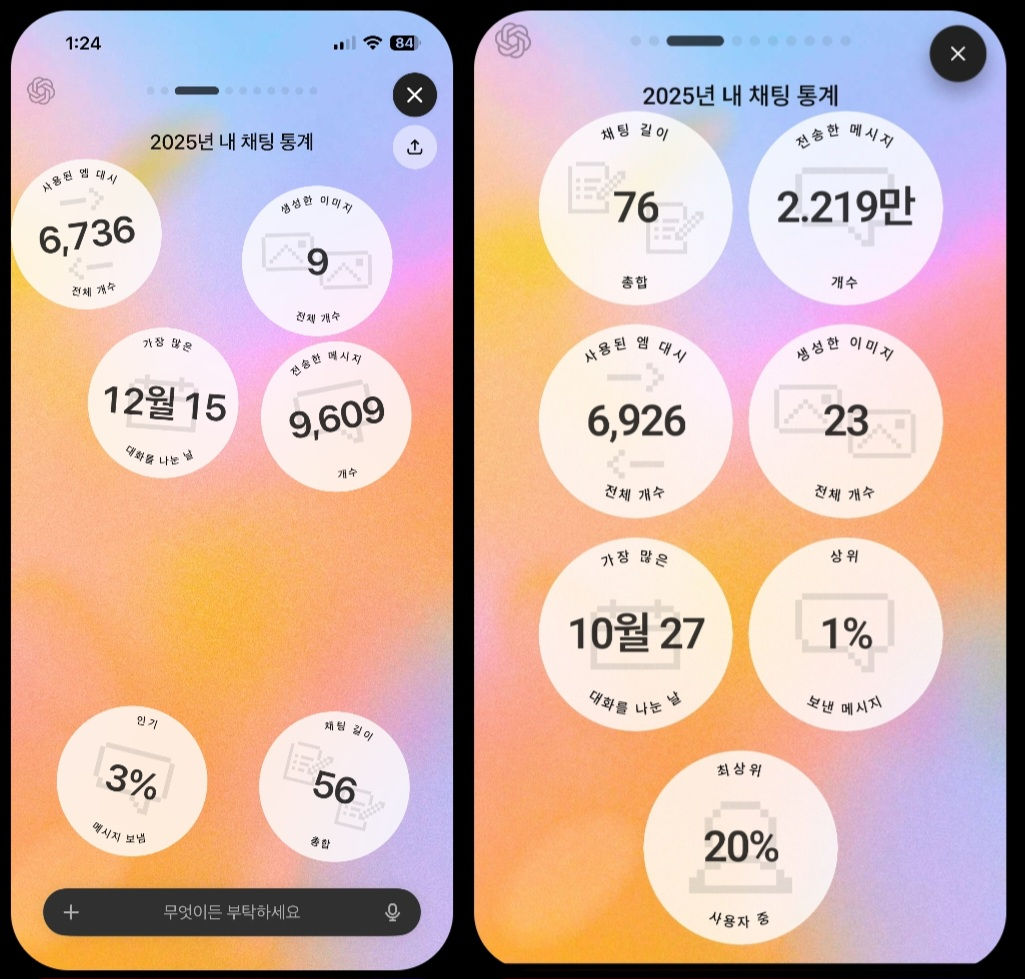
My 2025 ChatGPT usage summaries from two accounts. The interface is shown in Korean. Together, they show more than 31,000 messages sent across 132 chats. One account ranked in the top 1% by messages sent; the other ranked in the top 3%.
⸻
I didn’t start this journey by trying to build a product.
At the beginning, I was simply trying to make AI useful in the reality of my life.
Not in a perfect demo.
Not in a clean laboratory setting.
In real life.
With real work, real pressure, real decisions, real projects, and real problems that did not wait for me to organize them perfectly.
Like many people, I first used AI for answers. I asked questions. I explored ideas. I used it to write, summarize, plan, and think through problems.
But over time, my use of AI changed.
It stopped being something I occasionally consulted.
It became part of how I worked.
Part of how I made decisions.
Part of how I organized projects.
Part of how I survived complicated seasons of life and business.
And when AI becomes that deeply connected to your work, a different kind of problem begins to appear.
For me, the biggest problem was not intelligence.
It was continuity.
I could spend hours working through a project with AI. We could define direction, make decisions, organize priorities, and build momentum.
Then later, I would move into another conversation or return to the work after some time had passed, and too much of the working state would be gone.
The old conversation might still exist.
The text might still be there.
But the project did not always continue as a living whole.
That difference mattered.
At first, I thought the problem was memory.
Maybe AI just needed to remember more.
Maybe a larger context window would solve it.
Maybe storing more conversations would be enough.
But the more I used AI, the less I believed that storage alone was the answer.
A long-term project is not just text.
It contains decisions, direction, priorities, assumptions, risks, unresolved questions, and the reasons behind previous choices.
A system can preserve words and still lose what matters.
Somewhere along the way, I realized I was not really studying AI anymore.
I was studying continuity.
Not only how AI remembers.
But how humans keep meaningful work moving forward over time.
That realization changed the way I thought about the problem.
I stopped thinking about memory as storage.
I started thinking about continuity as infrastructure.
In 2025 alone, across two ChatGPT accounts, I sent more than 31,000 messages across 132 chats.
Yes, I know.
Seeing those numbers together makes me look slightly insane.
But the number itself is not the point.
The point is what those conversations represented.
I was not casually chatting with AI for entertainment.
I was using AI across business work, product development, research, writing, planning, documentation, strategy, daily problem-solving, and long-term projects that overlapped with one another.
I was effectively testing what happens when AI stops being a tool you occasionally use and becomes part of how you operate.
And when you use AI that way, discontinuity becomes expensive.
If AI forgets a small preference, you can repeat it.
But if it loses the state of a project, the cost is much higher.
If it forgets why a decision was made, future decisions can drift.
If priorities disappear, the work can move in the wrong direction.
If unresolved risks are lost, old problems return.
If different projects are connected but the AI treats them as separate conversations, I has to manually rebuild the connection again and again.
That is when I began to understand something:
The more deeply AI became part of my work, the more costly discontinuity became.
I did not know at the time that I was building a research journey.
I was simply trying to make AI work inside the reality of my life.
Something failed, so I tried to fix it.
Another limitation appeared, so I changed the structure.
A conversation broke continuity, so I looked for a way to preserve the project state.
A decision was forgotten, so I tried to anchor the reasoning behind it.
A project became fragmented, so I searched for ways to reconnect it.
Over time, the pattern became clear:
Apply AI to real life and work.
Observe what breaks.
Identify why it breaks.
Change the structure.
Test again.
Preserve what works.
Continue.
That loop became more important than any single prompt.
Prompts can improve an interaction.
But long-term work requires something deeper.
It requires the ability to carry forward what still matters.
Looking back now,
I don’t think I was simply teaching AI how to help me.
I think that time was teaching me how people actually learn to work with AI.
This is why I became interested in a very specific question:
Can an AI preserve decisions, direction, and project state across sessions without forcing the user to constantly re-explain everything?
I am still researching that question.
I do not claim that the problem is perfectly solved.
It is not.
There are still failures.
There are still limits.
There are still moments when context must be recovered, corrected, or re-established.
But something has changed.
Today, with the structured system I use inside ChatGPT, I can continue multiple long-term projects across different conversation spaces far more effectively than before.
I can return to older work.
I can move between related projects.
I can continue a direction without rebuilding everything from zero.
Not perfectly.
Not magically.
And not without structure.
But enough that my relationship with AI has changed.
I no longer see continuity as a convenience feature.
I see it as one of the foundations of serious human-AI collaboration.
Because the future of AI will not depend only on how intelligent a model is inside one conversation.
It will also depend on whether meaningful work can continue across time.
That is the problem that eventually led me to EnviOS.
Not because I wanted to create another AI tool.
Not because I thought people simply needed more prompts.
But because I kept running into the same problem again and again:
Without continuity, long-term work with AI keeps breaking apart.
EnviOS grew from that experience.
From tens of thousands of messages.
From repeated failures.
From real work.
From trying to connect AI with life, business, research, and long-term projects.
And from the belief that AI should not only answer well in the moment.
It should help preserve direction over time.
I am still testing.
Still learning.
Still finding where continuity breaks.
Still improving the structure.
But after everything I have seen, one belief has become stronger:
Memory is not enough.
Context is not enough.
A long conversation is not enough.
For AI to become a true long-term partner, it must be able to carry forward meaning, decisions, and direction.
I still don’t know exactly where this journey will end.
But after everything I have experienced,
I no longer believe the future of AI depends only on better models.
I believe it also depends on whether humans can continue meaningful work without losing themselves along the way.
That is the work I will continue.
⸻
Author’s Note
This essay reflects my personal experience from sustained, high-volume AI use across real work, long-term projects, experimentation, and daily life.
The screenshots are included as context for the scale of usage, not as proof that the continuity problem has been fully solved.
My goal is to document what I experienced, what repeatedly failed, what I tried to improve, and why I believe continuity will matter deeply in the future of human-AI collaboration.
Comments